 Konrad Völkel
Here is the second part of my walk-through to Voevodskys A¹-homotopy theory:
On page 48, the first Lemma is shown. Without proof - so I will try to illuminate things a little bit by giving the proof. This lemma isn't used until section 3, so you can skip it, if you want to. I suggest not to do so, if you are intimidated by the diagram, because it isn't that hard, and it's a nice exercise to get the concepts in your head right.
A detailed explanation
The lemma states, that a monomorphism between simplicial sheaves induces maps and whose fiber coproduct ist the space
Preliminaries
What is ?
First, there is a category , whose objects are just finite integer sequences . One considers the opposed category (May writes instead), whose morphisms are defined to be the monotonic maps. Then . It is important to understand the nature of these monotonic maps - read at least the first chapter in Mays "Simplicial Objects in Algebraic Topology". You will then see, that a simplicial set ist just a functor , just as any simplicial object ist a functor from .
For each object , define , a functor , thus a simplicial set. Together with the embedding of sets as constant sheafs, this gives us a simplicial sheaf , which is what is meant here. Observe that we have a functor by sending a map to the morphism . This functor is a cosimplicial object and turns the category of simplicial sheaves on the site T into a simplicial model category (that is, a model category which is compatibly enriched over simplicial sets, so the Hom-Sets are simplicial sets) with the simplicial function object
We will talk in detail about the simplicial model category structure later.
So what is ?
It's defined to be where and for is the -skeleton of , that is the image of the "obvious" functor , which may not be so obvious at first sight. Remember that and are both contravariant functors into the category of simplicial sets, so by Yoneda lemma we have . This gives us an interpretation of as , where the is taken in the category of functors. The "obvious" functor is the evaluation map. Observe that (by Yoneda Lemma) for we have , where corresponds to .
At the moment, we don't care about the right adjoint (coskeleton) of the skeleton functor.
What is ?
It's defined to be , the union of all degenerated -simplices that come from (therefore the name deg). In Mays book "Simplicial Objects", this is written . Another equivalent definition would be .
The statement of the lemma explained
What are these complicated looking objects in the diagram?
Let's look at the following pushout diagram:
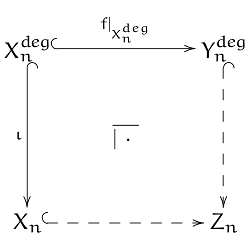
Y_n^deg and X_n^deg -> X_n, denoted by Z_n." width="250" height="250" />$$$$
Where I have given the name to make it look less scary. The letter denotes inclusion. There is clearly an inclusion and the restriction of gives an arrow and by pushout property we get a unique arrow that makes the diagram commutative:
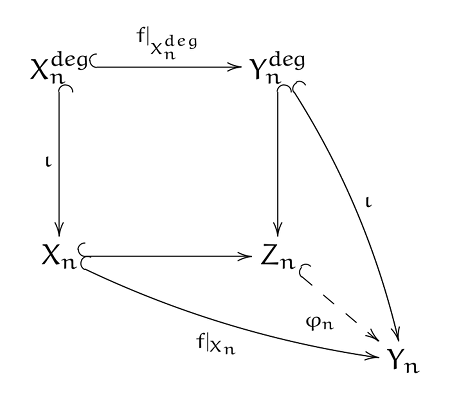
Y_n" width="450" height="400" />$$$$
The next step is again a pushout diagram:
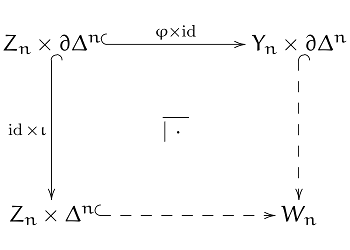
Y_n x del Delta^n and id x iota : Z_n x del Delta^n --> Z_n x Delta^n, denoted by W_n" width="350" height="250" />$$$$
Where I have given the name . We have morphisms and that give us by the pushout property a unique arrow .
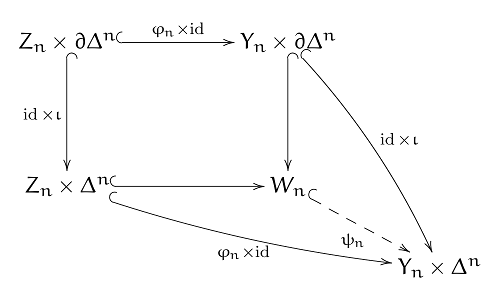
Y_n x Delta^n" width="500" height="300" />$$$$
What are the maps in the cocartesian diagram?
The arrow constructed above is the left arrow of the diagram. The right arrow can only be an inclusion . The bottom arrow is just the evaluation morphism explained above .
To construct the top arrow, look at the pushout defining above. The composition of with the evaluation morphism and the evaluation morphism give us, by pushout property, a unique morphism .
Proof
To check that the diagram is cocartesian means to check that has the pushout property in the diagram
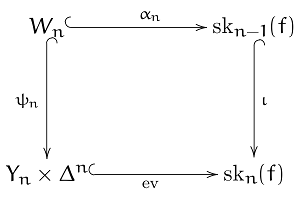
sk_{n-1}(f) and psi : W_n -> Y_n x \Delta^n" width="300" height="200" />$$$$
Take a test object together with morphisms and such that . We have to find a unique morphism that makes the whole diagram commutative.
For a moment, think about the sheaves as sheaves on , so our category is just the category of simplicial sets. We can prove the theorem in this case:
Remember . For each we can define . For we see that lies in the image of the (monic) evaluation map from , so we can define . Is well-defined? If has a preimage under the evaluation map, it lies in ; if it has at the same time a preimage of , it lies in , which lies in the image of the map , therefore we seee that is well-defined.
Uniqueness? If we'd have a second map , but , then we would have a such that . Such a can't have a preimage under the inclusion of or the evaluation on . So and . Nothing remains, so doesn't exist.
The general case is done by applying all points respectively all points , which are finite limit- and finite colimit-preserving functors. We can apply the lemma for the point case (which we have proved just before) and deduce from its validity for all points its validity in general (since our site has enough points - we took only like that in the beginning).